How to Write a Book with AI and Publish on Amazon KDP
Learn how to write and publish a book using AI on Amazon KDP. Covers AI content rules, best practices, and how to avoid AI detection.
The rise of AI writing tools has revolutionized self-publishing. Authors are now using ChatGPT, Claude, and other AI assistants to write entire books in weeks instead of months. But with this opportunity comes important questions: Is it allowed? How do you do it effectively? And what about AI detection?
This guide covers everything you need to know about writing a book with AI and publishing it on Amazon's Kindle Direct Publishing (KDP) platform.
Can You Publish AI-Written Books on Amazon KDP?
Yes, you can publish AI-assisted content on Amazon KDP - but there are rules you need to follow.
Amazon's Current AI Content Policy
Amazon updated its KDP content guidelines to address AI-generated content directly. The policy makes an important distinction between two categories:
- AI-generated: Content created entirely by an AI tool, even if you edited it afterward. This must be disclosed during publishing.
- AI-assisted: Content you wrote yourself, using AI only for editing, refining, error-checking, or brainstorming. This does not require disclosure.
The distinction matters. If you use ChatGPT or Claude to generate chapters (even if you edit them heavily), that's AI-generated and requires disclosure. If you write your own chapters and only use AI to proofread or suggest better phrasing, that's AI-assisted and no disclosure is needed.
During the publishing process, Amazon asks whether AI tools were used to create your text, images, and translations. You must answer honestly. Here's what the disclosure form looks like:
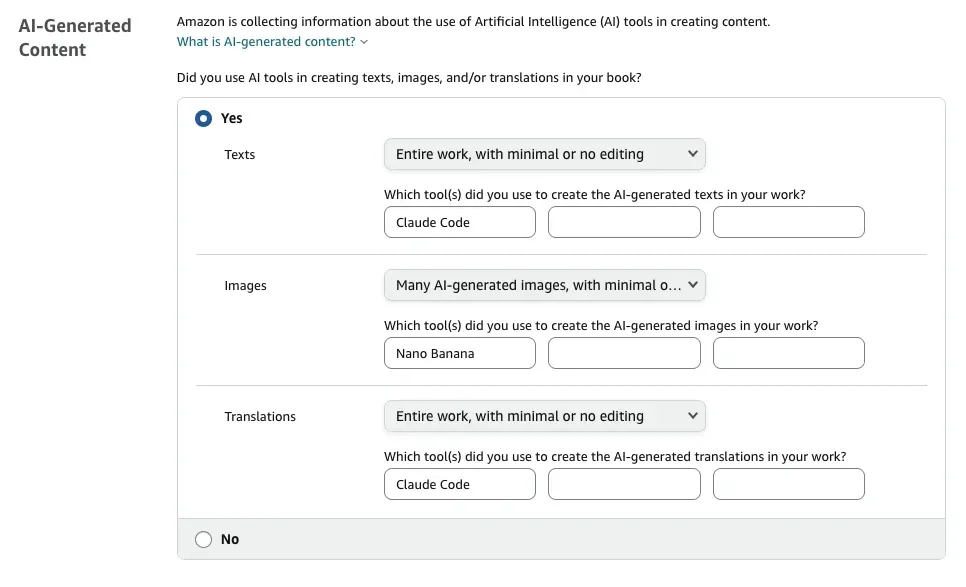
Even with AI assistance, you remain fully responsible for ensuring the content meets Amazon's guidelines, including copyright and quality standards. Amazon expects authors to review and edit AI-generated content. Simply uploading raw AI output without editing isn't recommended and could result in quality issues or account problems.
You also cannot publish content that includes AI-generated elements infringing on existing copyrights or trademarks. The key takeaway? Amazon hasn't banned AI content. They've created a framework requiring transparency and accountability.
Choosing the Right AI Tools for Book Writing
Not all AI tools are created equal when it comes to long-form content like books. Here's a breakdown of your options:
| Tool | Pros | Cons |
|---|---|---|
| ChatGPT | Excellent creative writing, follows style guidelines well, widely accessible, affordable | Can lose track in long books, repetitive patterns in long texts |
| Claude | Large context window, strong consistency, excellent at detailed instructions | Can be cautious with certain content |
| Claude Cowork | Real-time collaboration, work on documents together, great for iterative editing | Requires Pro subscription |
| Gemini | Very large context window, good at long documents | Less refined for creative writing, can be verbose |
| Sudowrite | Built specifically for fiction, story engine, character tracking, style matching | Subscription cost, focused on fiction only |
| NovelAI | Specialized for storytelling, privacy-focused | Steeper learning curve, smaller community |
| Jasper | Marketing and non-fiction focused, templates, brand voice features | Less suited for fiction, can feel formulaic |
| Notion AI | Integrated with note-taking, good for planning and outlining | Limited for long-form generation |
The Context Window Problem: Why ChatGPT Loses Track
One of the biggest challenges when writing a book with AI is the context window limitation. This is crucial to understand.
What's a Context Window?
AI models can only "see" a limited amount of text at once. This is called the context window. Modern models have significantly expanded these limits: ChatGPT offers context windows ranging from 128K to over 1 million tokens depending on your plan, while Claude provides up to 200K tokens. Despite these improvements, even a million tokens (roughly 750,000 words) can fill up quickly when you factor in system prompts, your instructions, and back-and-forth conversation history.
Why This Matters for Book Writing
A typical novel runs 60,000-100,000 words, far more than any AI can hold in its context window at once. As you progress through your book, the AI gradually forgets earlier chapters. Character details become inconsistent: eye colors change, backstories shift, and plot threads get dropped or contradicted. Your carefully established writing style can drift into something different by chapter twenty.
How to Work Around Context Limitations
The solution is to become your AI's memory. After completing each chapter, write a detailed summary you can feed back to the AI later. Maintain a "bible" document with character descriptions, plot points, and world-building details, and paste relevant sections when starting new chapters.
Rather than writing linearly from start to finish, break your book into manageable sections that fit within the context window. Start each writing session with a brief "story so far" summary plus specific details about what's about to happen. This "previously on..." technique keeps the AI grounded in your narrative.
Why Planning First Makes or Breaks Your AI Book
Here's the secret that separates successful AI-assisted books from failures: extensive planning before you write a single chapter.
When you write without AI, your brain maintains continuity automatically. With AI, you need to externalize that planning into documents you can reference. Create a synopsis, character profiles, chapter outline, and style guidelines. The more detailed these reference documents, the more consistent your AI output will be, and the easier it becomes to feed the right context at the start of each writing session.
Most importantly: bring your own original ideas. AI excels at writing prose, but it can only work with what you give it. Without your unique insights, perspectives, and story ideas, the output will be generic and forgettable. The best AI-assisted books combine the author's original thinking with AI's writing capabilities, not the other way around.
The workflow is simple: plan thoroughly, generate chapter by chapter (feeding relevant context each time), edit for consistency, then polish for publication. Expect several weeks, not several days.
Making AI Content Sound Natural
Raw AI output often has telltale signs that experienced readers (and detection tools) can spot. The language tends to be overly formal, with repetitive sentence structures and excessive transitions like "Furthermore," "Moreover," and "Additionally." Paragraphs come out perfectly balanced in length, contractions are rare, and the personal voice that makes writing engaging is entirely absent.
Editing Tips for AI-Generated Books
Start by reading your content aloud. Your ear catches awkward phrasing that your eye misses. Pay special attention to sentence length. AI tends toward medium-length sentences exclusively. Add some short punchy ones. Then occasionally, a longer, more complex sentence that takes the reader on a journey through multiple clauses before arriving at its destination.
Inject your personality throughout. Insert personal anecdotes, strong opinions, and observations that only you would make. This is what transforms generic AI output into something distinctly yours.
Be ruthless with hedging language. AI loves phrases like "it's important to note" and "one might consider". Cut them all. Similarly, replace generic transitions ("Additionally," "Moreover") with specific connections to your actual content.
The AI Detection Issue (Even for KDP)
Here's something most AI book guides don't tell you: even though Amazon allows AI-assisted content, AI detection still matters.
Why Detection Matters for Authors
Some readers actively run books through AI detectors and leave negative reviews when they detect AI content, regardless of Amazon's policies allowing it. Beyond reader perception, platforms may tighten their policies in the future, and content that reads naturally protects you from such changes.
There's also a quality perception issue: content that "sounds AI" correlates with lower quality in readers' minds, even when the information is excellent. And if you plan to repurpose your book content for blogs, articles, or other platforms, you may encounter stricter AI policies elsewhere.
The Reality of AI Detection
Modern AI detectors identify AI-written content with surprising accuracy. They analyze perplexity (how predictable word choices are), burstiness (variation in sentence length), common AI phrases, and statistical patterns in word usage. Even heavily edited AI content often retains traces of the original patterns. Tools like GPTZero, Originality.ai, and Turnitin improve their detection capabilities continuously.
How to Make AI Book Content Undetectable
This is where an AI humanizer becomes essential. Even if you're disclosing AI use to Amazon (as required), you want your content to read naturally and avoid triggering negative reader reactions. For longer sections, our AI Stealth Writer can help maintain a natural voice throughout.
The practical workflow is straightforward: generate your content with your AI tool of choice, then edit and revise to add your personal voice. Next, run the content through an AI humanizer like Humanizer AI to eliminate detectable patterns. Verify the result with an AI detector to confirm it passes, then do a final review to ensure your meaning is preserved.
The humanization step transforms text that "sounds AI" into content that reads naturally, with varied sentence structures and authentic-sounding prose while keeping your original meaning intact.
Publishing Checklist for AI-Assisted Books
Before you hit publish on KDP, make sure you've:
- Completed Amazon's AI disclosure accurately
- Edited every chapter for consistency
- Checked character details throughout
- Verified plot threads are resolved
- Ensured your voice comes through
- Run content through quality checks
- Considered humanization for natural reading
- Formatted properly for Kindle
- Created a compelling description (also humanized if AI-written)
- Designed or commissioned a professional cover
The Bottom Line: AI is a Tool, Not a Replacement
AI has made book writing accessible to more people than ever. You can now write that novel you've been thinking about, create that non-fiction guide, or finally publish your expertise - all with AI assistance.
But successful AI-assisted publishing isn't about letting AI do all the work. It's about using AI as a powerful collaborator while you provide the planning, oversight, editing, and that essential human touch that turns good content into great books.
The authors finding success with AI aren't the ones who generate and publish raw AI output. They're the ones who plan meticulously, edit carefully, and ensure their final product reads like it was written by a skilled human author - because in many ways, it was.
Ready to humanize your AI-written book content? Try Humanizer AI to transform your AI drafts into natural, engaging prose that readers will love. Start with our AI detector to check your current content, then humanize any sections that need it.
Read Next
Is AI Capable of Original Thought? What Pattern Matching Really Means
Can AI truly think for itself? Explore how LLMs generate text through pattern matching, why this creates detectable signatures, and what it means for AI detection.
How to Humanize AI Text: 7 Methods That Actually Work in 2026
Learn how to humanize AI text with proven methods that bypass GPTZero, Turnitin, and Originality.ai. We cover what works and what doesn't.
Can Turnitin Detect ChatGPT? What Students Need to Know
Yes, Turnitin can detect ChatGPT content. Learn how it works, accuracy rates, limitations, and what happens when you get flagged for AI writing.